


- Author: Abigael Wanjala
- Date: July 9, 2026
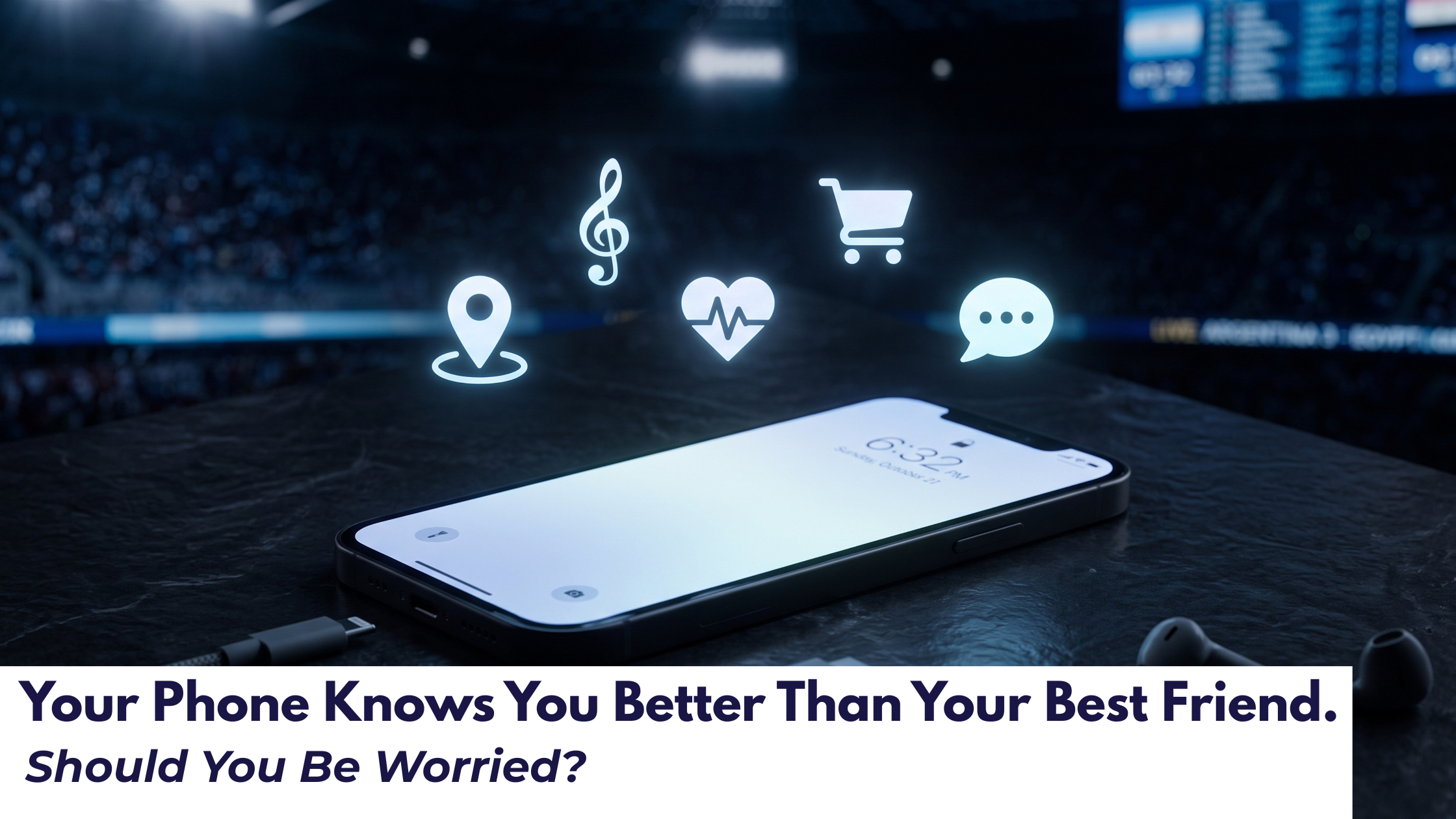
Your Phone Knows You Better Than Your Best Friend. Should You Be Worried?
Let us start with a small experiment.
Think of the last time you mentioned something in passing, out loud, to another human in a conversation, and then saw an ad for exactly that thing within the hour. You looked around the room. Nobody was listening. Just your phone, sitting innocently face down on the table like it had not just read your mind.
You thought it was just a coincidence?
Pole sana. It was not.
Your Phone Has Been Taking Notes
Here is the thing nobody tells you when you excitedly unbox a new smartphone: you are not just getting a device. You are entering a relationship. And like all relationships, it starts with small exchanges of information that feel harmless, until one day you realise this thing knows your sleep schedule, your mood patterns, your deepest grocery preferences, and the fact that you Google symptoms at 2am instead of going to the doctor like a responsible adult.
Your phone knows what time you wake up. It knows which apps you open first. It knows how long you stare at a screen before putting it down. It knows your location history so thoroughly it could write a more accurate diary of your week than you could.
This is not a joke.
And the strangest part? We handed over all of this information completely voluntarily. In exchange for free apps, turn by turn directions, and the ability to settle arguments about who sang what song in 1994 within four seconds.
Absolutely worth it. Probably.
The Upgrade That Was Not Optional
Here is what nobody warned us about the smartphone era: every upgrade was quietly also an upgrade in how much these devices could learn about us.
The first phones just made calls. Revolutionary. Then they added cameras, and suddenly our memories lived in someone else’s servers. Then they added health trackers, and now your wrist is filing detailed reports about your heart rate, your stress levels, and the number of steps you took to reach the fridge during the commercial break.
Then came the AI assistants. And this is where things got genuinely interesting, in the way that a nature documentary is interesting right before something dramatic happens to a wildebeest.
You can now have a full conversation with your phone. You can ask it to summarise a document, write an email in your tone, suggest what to cook based on what is in your fridge, and remind you to call your mother, which it will do because it noticed you have not spoken to her in three weeks and your stress indicators have been elevated.
Your mother would be thrilled. Your privacy? Slightly less so.
The AI That Finished Your Sentence
The latest generation of AI tools is doing something that would have sounded like science fiction five years ago: they are finishing our thoughts.
You start typing a message and the phone suggests the next word. You open an email app and it drafts a full response before you have decided what you want to say. You search for a product and it has already calculated what you will probably buy next based on what you bought last time.
This sounds convenient. It is convenient. That is exactly what makes it worth thinking about.
Because there is a difference between a tool that helps you do what you want and a tool that decides what you want before you have finished deciding. The first one is a hammer. The second one is something slightly more complicated.
And we are living through the era of the second one.
Technology inasonga mbele kwa kasi. Sometimes faster than our ability to decide how we feel about it.
At this point in the smartphone AI era, humanity has divided itself into roughly three camps.
The first camp is fully aboard. These are the people who have named their AI assistant, have automated roughly 60% of their daily decisions, and will argue passionately at a dinner table that they are more productive, more organised, and sleeping better than ever. They are probably right. Their digital footprint is also roughly the size of a continent.
The second camp is deeply suspicious. These are the people who put tape over their laptop cameras, use three different browsers for different purposes, and read every terms and conditions document in full, if such people exist. These individuals are technically correct about most of their concerns and also exhausted.
The third camp, the largest one, is everyone else. People who vaguely know something is going on with their data, find the convenience genuinely useful, occasionally feel a low grade unease when the algorithm gets too accurate, and have not yet made a firm decision about any of it.
If you are in the third camp, welcome. It is the most honest place to be.
The AI That Finished Your Sentence
Given that the word artificial intelligence now appears in approximately every product description, news headline, and startup pitch in existence, it is worth being clear about what we are actually talking about.
At its most straightforward, AI is pattern recognition at scale. You feed a system enormous amounts of data, it finds patterns in that data, and then it uses those patterns to make predictions. What word comes next in a sentence. What product you might buy. Whether this email sounds like spam. Whether this photo contains a cat.
It is extraordinarily good at this. Better than humans, in many specific tasks. But it is not thinking. It is not conscious. It does not have opinions or intentions.
What it has is access to a lot of information, including yours, and the ability to use that information very quickly to produce outputs that feel surprisingly human.
Hii ndiyo inayofanya watu waogope. Not that machines are becoming human. But they are becoming very good at seeming like it.
The Part That Is Actually Exciting
Here is where we pivot, because this article is not a warning. It is a Thursday, and warnings are for Mondays.
The genuinely exciting thing about where AI and technology are going is not the surveillance angle. It is the access angle.
For most of human history, the best advice, whether financial, medical, legal, or educational, was available only to people who could afford to pay for it. You needed an accountant to manage complex finances. A lawyer to understand a contract. A doctor who had time to explain things in full. A teacher who could adapt to the way your brain works.
AI is beginning to change that. Slowly, imperfectly, and with many caveats. But meaningfully.
A first generation university student can now get personalised academic support at 11pm on a Wednesday. A small business owner in Thika can access financial planning tools that were previously available only to large corporations. A person who never had access to financial education can have their questions answered patiently, in as much detail as they need, without judgment.
This is the real power.
Not that AI can write your emails. But it is beginning to close gaps that money and geography used to make permanent.

Kidogo tu.
Not in a dramatic, dystopian, run to the hills kind of way. But in the same sensible way you would be thoughtful about any relationship where one party knows significantly more about you than you know about them.
Ask occasionally what the apps on your phone are actually tracking. Read the privacy settings, not because you will understand all of it, but because the act of paying attention matters. Be aware that the convenience is not free. It is funded by your data, and knowing that changes how you relate to it.
But also: use the tools. Let the AI help you with the things it is good at. Allow technology to give you access to things you did not have access to before. Be the person who uses the hammer without worshipping it.
And when your phone finishes your sentence in a way that is a little too accurate, just smile.
You are known.
The question is only what you do with that.
Facebook
Twitter
LinkedIn
WhatsApp
Your Phone Knows You Better Than Your Best Friend. Should You Be Worried?
Author: Abigael Wanjala Date: July 9, 2026 Your Phone Knows You Better Than Your Best Friend. Should You Be Worried? Let us start with a small experiment. Think of the last time you mentioned something in passing, out loud, to another human in a conversation, and then saw an ad
You Are Not Lazy. You Are Just Running On Empty.
Author: Abigael Wanjala Date: June 25, 2026 Let us have an honest conversation. It is 7:30 in the evening. You have been meaning to go to the gym since January.
The Quite Power of Compound Interest
Author: Abigael Wanjala Date: June 18, 2026 There is a reason wealthy people rarely talk about luck and almost always talk about time. The secret is not a secret at
The 5-to-8 After the 8-to-5: Nurturing Hobbies in a Hustle Culture World
Author: Abigael Wanjala June 11, 2026 Nurturing Hobbies in a Hustle Culture World Someone, somewhere, decided that your evenings belonged to productivity. That the hours between clocking out and going
Building More Than Savings: The Mombo Sacco Community Story
Author: Abigael Wanjala Date: June 4, 2026 Something Special Is Growing Here It started with a simple idea. That Kenyans deserve a financial community that actually shows up for them.
Three Trends Reshaping the Value of a Shilling
Author: Ng'ang'a S. Date: May 29, 2026 Three Trends Reshaping the Value of a Shilling The rules of money in Kenya are being rewritten. Money is no longer just something
The “Thursday Pause”: Why Thursday Is the Best Day to Do a Vibe Check on Your Spending
Author: Abigael Wanjala Date: May 21, 2026 Why Thursday Is the Best Day to Do a Vibe Check on Your Spending There is something that happens every single week without