


- Author: Abigael Wanjala
- Date: July 16, 2026
The Life You Keep Postponing
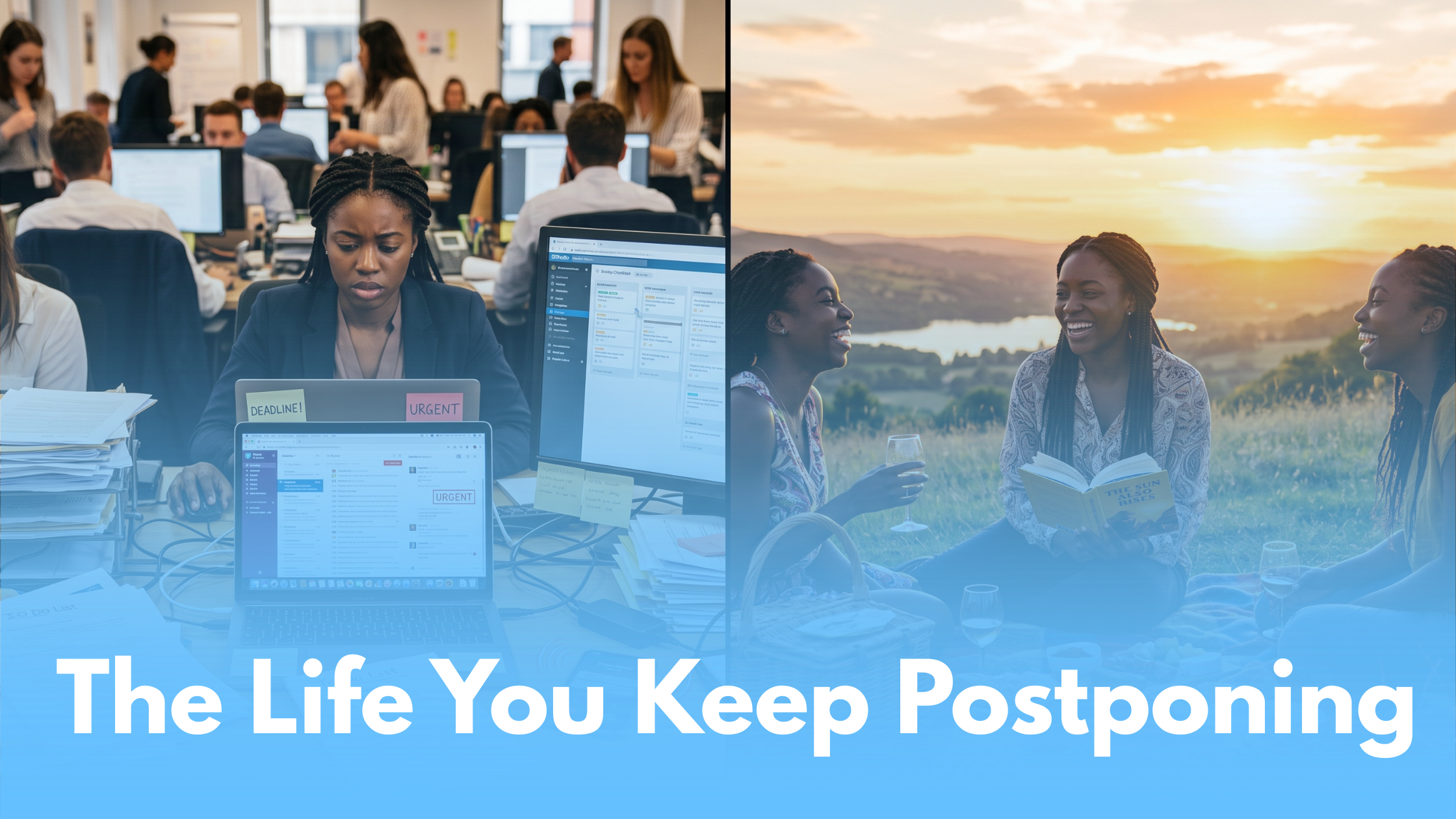
There is a version of your life that you have been meaning to get to.
You know the one version where you finally slow down enough to cook a proper meal on a weekday. Where you call the people you love not because something happened but just because it is a Tuesday and you were thinking of them. Where you take the weekend trip you have been saving in your browser tabs since February. Where you sit outside in the evening with nothing to do and feel, for once, completely fine about that.
That version of your life is not somewhere in the future. It has been waiting, quietly and without complaint, in the gaps between everything urgent.
Life is passing you by. Not dramatically. Just steadily, in the ordinary way that Tuesdays become Julys and Julys become years.
The Postponement Habit
We are remarkably good at postponing the things that actually sustain us.
Not because we do not value them. We do. We value rest. We value connection. We value the feeling of being present in our own lives rather than perpetually rushing through them toward some next thing that will, itself, require rushing toward something after it.
We postpone not because we are careless but because we have quietly accepted a story that says the good stuff comes later. After the deadline. After the promotion. After the loan is paid off. After things settle down, which they never quite do because life does not operate in chapters that conclude cleanly before the next one begins.
The philosopher Seneca wrote, nearly two thousand years ago, that people are careful with their money but wasteful with their time, which is the one thing that cannot be returned.
Hiyo ni kweli kabisa.
And two thousand years later, most of us are still doing exactly the thing he was describing.
We plan our finances with more intentionality than we plan our lives.
What Gets Postponed First
When pressure arrives, and it always arrives, there is a predictable order in which things get sacrificed.
Sleep goes first. Then exercise. Then the hobbies that do not produce anything useful. Then the slow mornings. Then the proper lunches. Then the conversations that are not about logistics. Then the friendships that require effort to maintain.
What remains, once all of that has been trimmed, is a life that functions but does not particularly feel like anything.
You are productive. You are responsive. You meet your obligations. You show up.
But somewhere in the efficient, optimised machinery of your days, the texture of living has gone a little thin.
Unafanya kazi lakini hukumbuki huishi.
And the difficult thing about this state is that it does not feel like a crisis. It feels like Tuesday. It feels normal. Which is precisely why it can go on for such a long time before anyone, including you, notices.
The Things That Do Not Make the To Do List
There is a category of things that matter deeply to human flourishing but never appear on a to do list.
Sitting with a cup of tea and genuinely doing nothing else. Watching the sun move across a room. Laughing at something until it becomes unreasonable. Walking somewhere without a destination or listening to a podcast. Having a conversation that goes nowhere in particular and lasts for three hours anyway.
These things do not produce output. They cannot be measured or optimised or presented in a quarterly report. There is no metric for how a slow Sunday afternoon compounds over time into a life that feels worth living.
And yet these are exactly the things that people mention when they look back. Not the deadlines they met. Not the efficient systems they built. Not the number of emails they cleared from their inbox on any given day.
They mention the Saturday market with someone they loved. The trip they finally took. The evening they sat on the balcony and watched the city and felt, briefly, like they were exactly where they were supposed to be.
The good things are not written in pen. They remain in the heart.
On the Guilt of Slowing Down
There is a particular guilt that comes with choosing rest or pleasure over productivity. A low hum of wrongness that follows you into the weekend, into the holiday, into the quiet evening you carved out for yourself.
I should be doing something.
This guilt is not random. It has been carefully constructed over decades of cultural messaging that ties human worth to output, that celebrates busyness as virtue, that treats rest as something you earn rather than something you need.
The result is that many people cannot actually enjoy the things they have worked so hard to access. The holiday is spent half thinking about work. The weekend is shadowed by Sunday anxiety. The quiet moment is interrupted by the compulsion to check, respond, and produce.
We have been so thoroughly trained to be productive that we have forgotten how to simply be.
And being, just being, without agenda or output, is not a luxury. It is a biological and psychological requirement. The mind that never rests does not perform better. It performs worse, more slowly, with less creativity and less resilience, until eventually it stops performing at all and presents its invoice in the form of burnout, illness, or a flatness that no amount of productivity can cure.
Kupumzika si luxury. Ni hitaji la kisingi.
The Small Reclamations
This is not an argument for quitting your job and moving to a farm, appealing as that sometimes sounds at 11pm on a Wednesday.
It is an argument for small reclamations. For deliberately, consciously choosing to inhabit your life rather than defer it.
What would it look like to take one evening this week and protect it, not for productivity, not for catching up, but for something that simply makes you feel like yourself? A book. A walk. A long conversation with someone you have been meaning to properly talk to. A meal cooked slowly with music on.
What would it look like to look at your weekend and, instead of filling every gap with errands and obligations, leave one stretch of it genuinely open, not to be filled later, but to remain open, and to see what you actually want to do with it when the time comes?
What would it look like to call someone you love not because you need anything but because it has been too long and they cross your mind sometimes in the way that people do when they matter to you and you have not said so recently?
None of these things require money or time off or a dramatic change in circumstances. They require only a decision to treat your life as something worth showing up for fully, not just the parts that are urgent, but the parts that are simply yours.

That version of your life, the one you have been meaning to get to, is not a future destination.
It is available right now, in ordinary moments, in the week you are already in. It does not require everything to be sorted first. It does not require the deadline to pass or the loan to clear or the situation to resolve.
It requires only that you look up from the urgent long enough to notice the rest.
Life is today.
Not when things settle. Not after the next milestone. Not someday when there is finally enough time.
Today. This week. This unremarkable, ordinary, quietly extraordinary Thursday that will not come back once it has passed.
Facebook
Twitter
LinkedIn
WhatsApp
The Wallet That Grew Up
The Wallet That Grew Up Author: Abigael Wanjala Date: September 10, 2026 Comments: No Comments There is a moment most of us remember, even if we do not talk about it often. The first time we sent money on a phone. For many Kenyans, that moment arrived with M Pesa
You Named It. Now Save For It.
Author: Abigael Wanjala Date: August 27, 2026 You Named It. Now Save For It. Somewhere on your phone right now, there is a screenshot.Maybe it is a holiday destination you
The Business That Almost Did Not Make It Past Year Two
The Business That Almost Did Not Make It Past Year Two Author: Mombo Sacco Date: August 20, 2026 Comments: No Comments Grace started her catering business the way many small
The Savings Account That Actually Fits Your Life
Here is something that happens to a lot of people who are trying to get serious about saving in Kenya.They decide they want to start. They look at their income,
What We Knew Before We Forgot
Author: Abigael Wanjala Date: August 6, 2026 What We Knew Before We Forgot There is a particular kind of wisdom that lives in childhood. Not the kind that comes from
From Harambee to Homepage: The Story of How Saccos Went Digital
Author: Abigael Wanjala Date: July 30, 2026 From Harambee to Homepage: The Story of How Saccos Went Digital Before there was an app, there was a table.A wooden one, most
Nobody Taught Us This. And It Shows.
Author: Abigael Wanjala Date: July 23, 2026 Nobody Taught Us This. And It Shows. Let us be honest about something.Most of us grew up in homes where money was either