


- Author: Abigael Wanjala
- Date: August 6, 2026
What We Knew Before We Forgot
There is a particular kind of wisdom that lives in childhood. Not the kind that comes from knowledge or experience because children have very little of either. It comes from not yet knowing what you are supposed to be afraid of. From not yet having learned to overthink. From approaching life with a directness that adulthood, for all its sophistication, tends to quietly dismantle.
We spend the first twenty years of our lives accumulating that wisdom without realising it. Then we spend the next forty years unlearning it in ways we rarely notice until something, perhaps a moment of exhaustion, a conversation with a child, or a memory that surfaces unexpectedly, makes us pause and think: when exactly did I stop doing that?
There is something in the directness of childhood that deserves more credit than we give it.
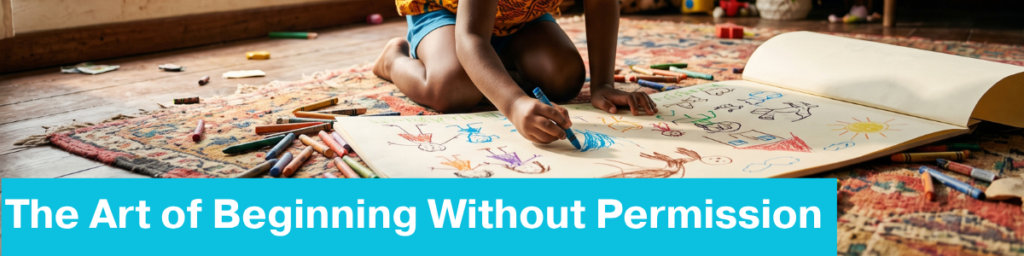
Watch a child decide to draw something.
There is no preliminary research. No consultation. No assessment of whether they are talented enough to attempt it or whether the conditions are quite right. They pick up the crayon and they begin. The drawing may bear no resemblance to what it was supposed to be. That is largely irrelevant. The point was never the outcome. The point was the doing.
Somewhere in the journey to adulthood, most of us lost this. We began requiring conditions before we would start. The right moment. The right tools. The right level of certainty that it would work out. We developed a relationship with beginning that is so shaped by preparation and permission seeking that many things simply never get started at all.
The child who picks up the crayon does not ask whether they are ready. They are not ready. They begin anyway, and readiness comes through doing.
Anza. Skills zitakuja badae.
This is perhaps the most radical thing childhood can teach adulthood. Not that preparation is worthless. It is not. The lesson is that at some point, beginning becomes the only preparation that truly counts.
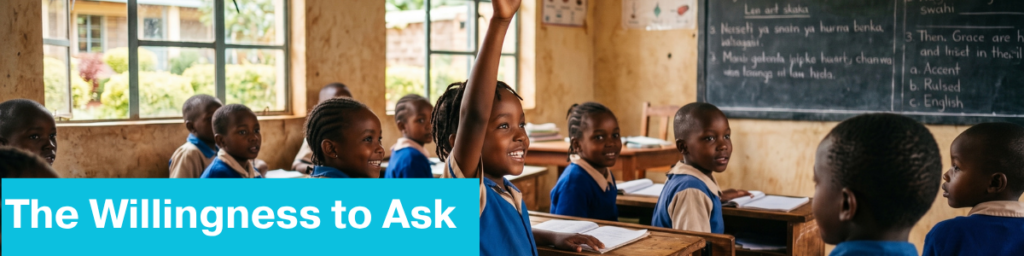
Children ask questions with a frequency and fearlessness that most adults have long since abandoned.
Why is the sky blue? Why do people die? Why does that person look sad? Why does this cost money? Why can we not just share everything?
These are not naive questions. Several of them are among the most profound questions philosophy and science have spent centuries attempting to answer. Children ask them without embarrassment because they have not yet learned that not knowing something is something to be ashamed of.
Adulthood teaches us, slowly and thoroughly, that questions reveal ignorance and that revealing ignorance is dangerous. In meetings, we nod along. In conversations, we pretend to understand. We Google things privately that we could have simply asked about. We navigate entire situations on the basis of partial information because asking for the full picture feels like an admission of inadequacy.
The cost of this is enormous and largely invisible. Decisions made on incomplete information. Relationships complicated by things left unasked. Opportunities missed because asking felt like too much of a risk.
A question carries no shame.
The child who asks why is not weak. They are efficient. They are getting directly to what they need to know without the long detour of pretending they already know it. That directness, recovered in adulthood, is a form of courage.
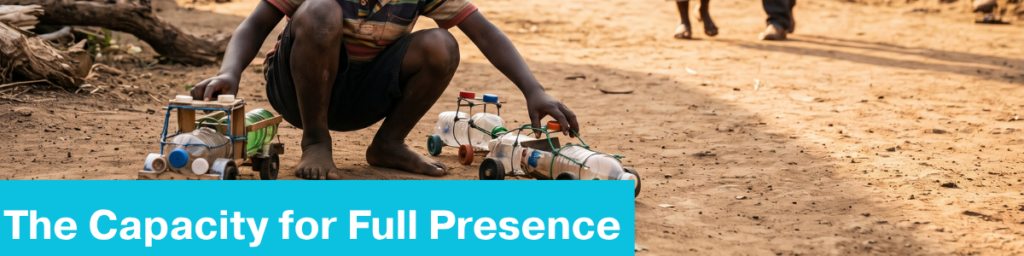
There is something a child does with play that adults struggle to replicate with almost any activity. They are entirely there.
When a child is building something with blocks, the blocks are the whole world. When they are chasing something in a compound, the chase is everything. There is no part of their attention held in reserve for tomorrow’s worry or yesterday’s mistake. The moment has their complete attention, so the moment is experienced fully in a way that most adult experiences simply are not.
We have a word for this now. Mindfulness. We have built an industry around teaching adults to recover a capacity that children exercise naturally every day.
The reason children experience joy so intensely and so frequently is not that their lives are objectively more joyful. It is that they are actually present for what is happening. The mango tastes like a mango because they are tasting it, not thinking about twelve other things while eating it. The game is fun because they are playing it, not monitoring how much fun they are appearing to have.
A child’s joy is in the present moment.
Adulthood brings real responsibilities that genuinely require planning and foresight. It also brings a habit of perpetual mental absence, being physically in one place while mentally scattered across several others. That habit robs ordinary moments of the richness they actually contain.
The child playing in the dust has something the stressed adult in the traffic jam has temporarily misplaced. Not freedom from obligation. Just the ability to be where they are.
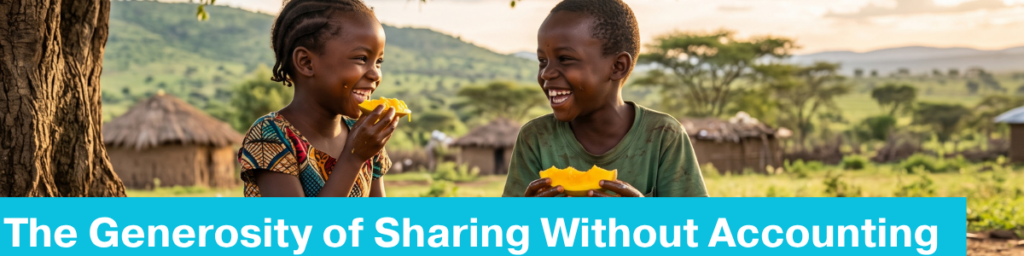
Watch children share food.
Not always, and not without negotiation because children are not saints. Even so, there is a generosity in childhood that has not yet been complicated by scarcity thinking, by keeping invisible tallies, or by the adult habit of giving with one hand while quietly calculating what is owed with the other.
A child who has sweets will offer one to a friend with an ease that most adults, if they are honest, have to consciously work to match. The adult brain has learned to count. To track. To balance. To notice who gave last time and whether this distribution seems fair.
These are not entirely bad instincts. Fairness matters, and blind generosity can be exploited. Somewhere in developing these protective calculations, however, many of us lost something. We lost the simple pleasure of giving without keeping a ledger. We forgot how genuine generosity feels when it is not accompanied by any arithmetic at all.
Sharing is joy. Not a transaction. Not strategy. Just the uncomplicated pleasure of having something and giving some of it away.
The adult who recovers even a fraction of this, who gives without immediately calculating the return and helps without keeping score, does not just make someone else’s day better. They make their own life lighter.
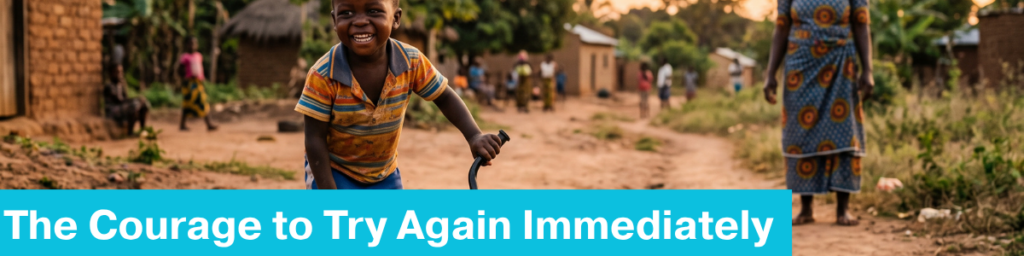
A child who falls down gets up.
This is so obvious it barely seems worth saying. Yet it contains something remarkable. The child who falls does not typically spend three weeks processing the fall before attempting to walk again. They do not construct an elaborate narrative about how falling reveals something fundamental about their relationship with the ground. They get up, perhaps cry briefly, and continue.
Failure in childhood is immediate and physical. Then, more or less, it is over.
Failure in adulthood is something else entirely. We carry it. We rehearse it. We use it as evidence in arguments we are having with ourselves about our own capacity. A single professional setback can shape how someone approaches their work for years. A financial mistake made in the twenties can make someone risk averse in ways that cost them far more than the original mistake ever did.
The child does not do this. Not because they lack the cognitive capacity for self reflection, but because they have not yet learned to treat failure as identity. The fall is something that happened. It is not something they are.
Anguka, simama, endelea.
This relationship with failure is quick, practical, and free from unnecessary drama. It is one of the most useful things childhood ever modelled for us and one of the hardest to recover once adulthood has taught us to treat every setback as a verdict.
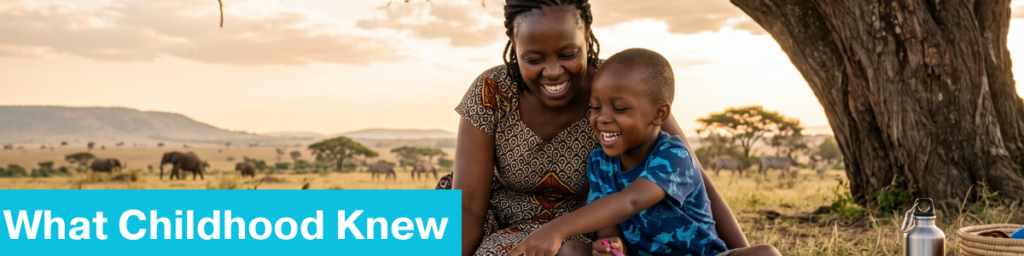
If you sit with it long enough, there is a pattern in all of these things.
Begin without waiting for permission. Ask without shame. Be where you are. Give without counting. Get up and try again.
None of these are childish ideas. They are, in fact, the operating principles of most people who live with a quality of aliveness that others find inspiring and slightly mysterious. They move through the world with less friction, more ease, and a more genuine connection to what they are doing.
They did not discover something new. They recovered something old.
The wisdom of a child does not expire.
It simply waits beneath the accumulation of everything adulthood taught you to become, waiting for the moment you decide to come back to it.
That moment can be this Thursday. It can be today. It can be the next time you pick up something new and feel the old familiar urge to wait until you are ready.
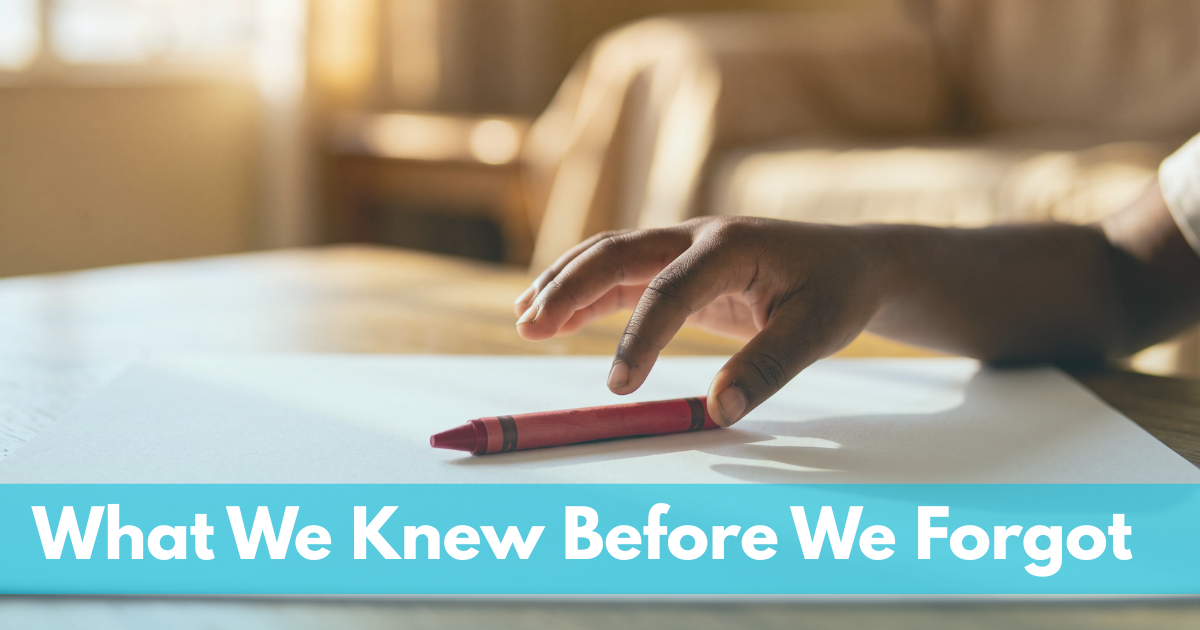
Pick up the crayon.
Facebook
Twitter
LinkedIn
WhatsApp
So Apparently AI Has Been Managing Your Money This Whole Time
Author: Abigael Wanjala Date: September 24, 2026 So Apparently AI Has Been Managing Your Money This Whole Time Okay so raise your hand if you have ever done any of the following.Googled "why is my account always empty before month end" at 11pm. Asked your Sacco app to categorise your
The Goal Everyone Should Be Saving Towards Together
Author: Abigael Wanjala Date: September 17, 2026 The Goal Everyone Should Be Saving Towards Together Let us talk about group money for a second. Not the Chama that fell apart
The Wallet That Grew Up
The Wallet That Grew Up Author: Abigael Wanjala Date: September 10, 2026 Comments: No Comments There is a moment most of us remember, even if we do not talk about
You Named It. Now Save For It.
Author: Abigael Wanjala Date: August 27, 2026 You Named It. Now Save For It. Somewhere on your phone right now, there is a screenshot.Maybe it is a holiday destination you
The Business That Almost Did Not Make It Past Year Two
The Business That Almost Did Not Make It Past Year Two Author: Mombo Sacco Date: August 20, 2026 Comments: No Comments Grace started her catering business the way many small
The Savings Account That Actually Fits Your Life
Here is something that happens to a lot of people who are trying to get serious about saving in Kenya.They decide they want to start. They look at their income,
What We Knew Before We Forgot
Author: Abigael Wanjala Date: August 6, 2026 What We Knew Before We Forgot There is a particular kind of wisdom that lives in childhood. Not the kind that comes from