


- Author: Abigael Wanjala
- Date: September 24, 2026
So Apparently AI Has Been Managing Your Money This Whole Time
Okay so raise your hand if you have ever done any of the following.
Googled “why is my account always empty before month end” at 11pm. Asked your Sacco app to categorise your spending and then immediately regretted seeing where your money actually goes. Ignored three notifications from a savings app because you were not ready to have that conversation with yourself. Or and this one is for a specific type of person who manually calculated whether you could afford something by staring at your balance for thirty seconds and then making a decision based entirely on vibes.
Hands up. We have all been there.
Here is the thing though. While most of us have been navigating our finances through a combination of guesswork, optimism, and occasional panic, something has been quietly changing on the other side of the screen. The apps we use every day have been getting smarter. A lot smarter. And the way technology is now interacting with personal finance is genuinely worth understanding, not because it is scary, but because it is actually useful.

You might not have noticed it happening, but artificial intelligence is already embedded in almost every financial interaction you have.
When your bank flags a transaction as suspicious and sends you a verification request, that is an AI that has learned your spending patterns well enough to notice when something does not look like you. When your mobile money app suggests a contact when you start typing a name, that is predictive AI using your transaction history. When a loan application gets approved or rejected in seconds rather than days, that is an AI powered credit scoring model running your data through thousands of variables faster than any human credit officer ever could.
None of this is new. But it is accelerating. And the direction it is heading is toward something that feels less like background automation and more like an actual financial assistant, one that knows your situation, understands your patterns, and can give you genuinely useful guidance in real time.
Technology knows you better than you think.

Let us talk about credit scoring specifically because this is one of the areas where AI is doing something genuinely transformative for ordinary Kenyans.
Traditional credit scoring was built for a very specific type of person. Someone with a formal salary, a bank account with consistent deposits, a history of formal lending and repayment. If you were a teacher or a civil servant with a payslip, the system worked reasonably well for you. If you were a market trader, a gig worker, a freelancer, or anyone whose income was variable or informal, the system basically did not see you. You were what the industry called “thin file.” Not a bad credit risk. Just invisible.
AI powered credit scoring changes this by expanding what counts as evidence of financial reliability. Instead of just looking at whether you have repaid formal loans, it looks at the full picture of your financial behaviour. How consistently do you pay your utility bills? What does your mobile money transaction history look like? How do you manage your wallet balance over time? Do you save regularly, even in small amounts?
These patterns, analysed at scale, turn out to be meaningful predictors of whether someone will repay a loan. And they are patterns that millions of Kenyans who were previously invisible to the formal credit system actually have.
This is not a small thing. Access to affordable credit is one of the most significant factors in whether a small business can grow, whether a family can smooth over an emergency without a crisis, whether someone can invest in an asset that changes their financial trajectory. AI is beginning to unlock that access for people the old system was never built to serve.
The new system sees you.

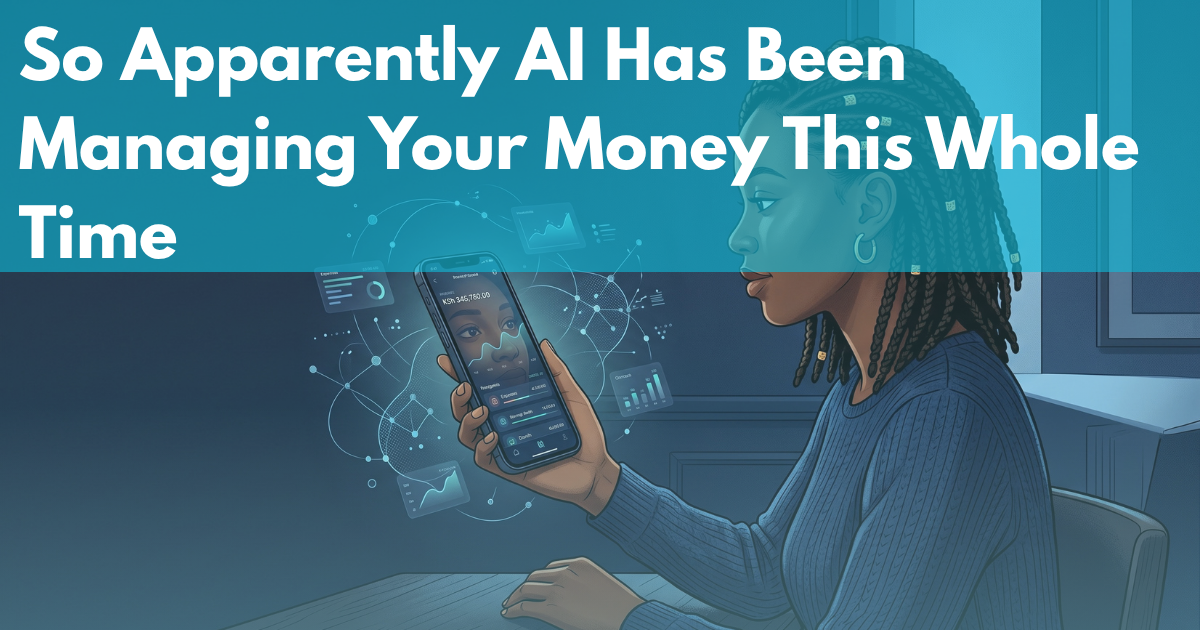
Beyond credit scoring, the more immediate way most people will experience AI in their financial lives is through the apps on their phones.
The most useful versions of this are not the ones that overwhelm you with data. They are the ones that take your data and turn it into something simple and actionable. You spent 40% of your income on food this month. Here is what that looked like compared to last month. You have a large expense coming up on the 15th. Based on your current balance, you might want to know. You have been consistently saving toward this goal and you are on track to hit it two weeks early. Nice work.
This kind of real time, personalised guidance used to require a financial advisor. Someone you paid to look at your numbers, understand your situation, and tell you what to pay attention to. Most people could not afford that. Now the basic version of it lives in your pocket, available at any time, for free.
The key word there is basic. AI powered financial tools are genuinely useful for the everyday management of money, including tracking, budgeting, goal progress, and spending patterns. They are not a replacement for human judgment on big decisions. But for the 80% of financial management that is just about staying organised, staying consistent, and staying aware, they are remarkably good.

None of this works if you do not engage with it.
This is probably the most important thing to say about AI and personal finance, and it is also the thing that tends to get left out of the enthusiastic technology articles. The tools exist. They are increasingly capable. But a smart savings app that you never open is less useful than a notebook and a pen that you actually use.
The people who benefit most from AI powered financial tools are the ones who have decided to be honest with themselves about their financial situation. Who actually looks at the spending breakdown instead of closing the notification. Who let the credit scoring system see their real transaction patterns instead of trying to game it. Who set up the automated saving rule and leave it alone instead of turning it off the first time the balance looks lower than comfortable.
AI can show you the picture. It cannot make you look at it.
The best tool in the hands of someone who is not ready is still just a tool.

Here is where this becomes practical rather than just interesting.
The shift toward AI powered financial tools means that the gap between people who actively manage their money digitally and people who do not is going to keep widening. Not because the people who do not are less capable or less disciplined, but because the tools available to active digital savers are compounding in their usefulness in ways that are hard to overstate.
Your savings history becomes your credit profile. Your transaction patterns become evidence of your financial character. Your consistency, even at small amounts, even with irregular income, becomes visible and valuable in a way it never was before.
Every month you save into a structured account, every consistent deposit into a goal, every repayment made on time, all of this is being read by systems that are increasingly capable of translating it into opportunity. Lower interest rates. Higher loan limits. Better products. More access.
The question is not whether this system is coming. It is already here. The question is whether you are building the kind of financial history that benefits from it.
Your record today is your door tomorrow.

Technology in personal finance is moving fast and it is not going to slow down. More of your financial life will be automated, predicted, and personalised in the next five years than in the previous twenty.
That is mostly a good thing, especially for the millions of Kenyans who were previously invisible to the formal financial system and who now have a real chance of being seen, assessed fairly, and given access to products that can actually help them grow.
But the underlying work is still yours to do. Save consistently. Track your spending honestly. Use the tools that are available to you, not because technology is going to fix your finances, but because it is going to amplify whatever financial habits you already have.
Good habits, amplified. That is the promise.
Facebook
Twitter
LinkedIn
WhatsApp
So Apparently AI Has Been Managing Your Money This Whole Time
Author: Abigael Wanjala Date: September 24, 2026 So Apparently AI Has Been Managing Your Money This Whole Time Okay so raise your hand if you have ever done any of the following.Googled "why is my account always empty before month end" at 11pm. Asked your Sacco app to categorise your
The Goal Everyone Should Be Saving Towards Together
Author: Abigael Wanjala Date: September 17, 2026 The Goal Everyone Should Be Saving Towards Together Let us talk about group money for a second. Not the Chama that fell apart
The Wallet That Grew Up
The Wallet That Grew Up Author: Abigael Wanjala Date: September 10, 2026 Comments: No Comments There is a moment most of us remember, even if we do not talk about
You Named It. Now Save For It.
Author: Abigael Wanjala Date: August 27, 2026 You Named It. Now Save For It. Somewhere on your phone right now, there is a screenshot.Maybe it is a holiday destination you
The Business That Almost Did Not Make It Past Year Two
The Business That Almost Did Not Make It Past Year Two Author: Mombo Sacco Date: August 20, 2026 Comments: No Comments Grace started her catering business the way many small
The Savings Account That Actually Fits Your Life
Here is something that happens to a lot of people who are trying to get serious about saving in Kenya.They decide they want to start. They look at their income,
What We Knew Before We Forgot
Author: Abigael Wanjala Date: August 6, 2026 What We Knew Before We Forgot There is a particular kind of wisdom that lives in childhood. Not the kind that comes from