


- Author: Abigael Wanjala
- Date: June 25, 2026
Let us have an honest conversation.
It is 7:30 in the evening. You have been meaning to go to the gym since January. Your water bottle is still in the shopping bag you bought it in. You told yourself you would have meal prep on Sunday and instead you watched four episodes of something you cannot even fully remember and ordered KFC at 11pm.
Be honest.
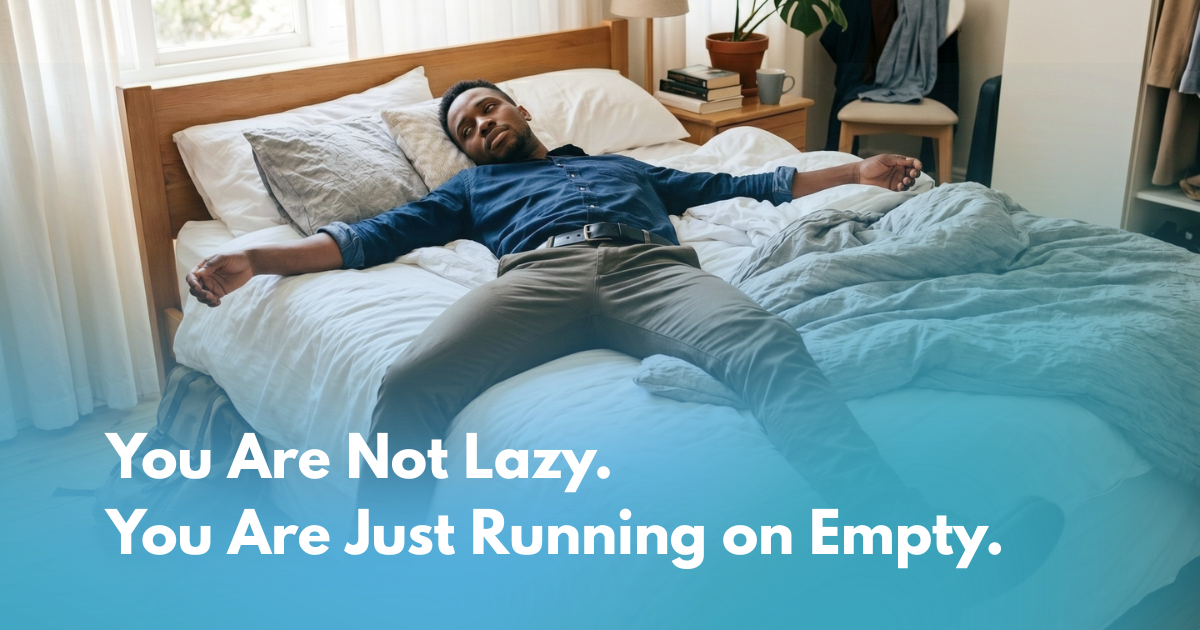
Before you spiral into a guilt trip about discipline and self-sabotage, here is something worth considering: the problem might not be your character. It might be your energy budget. And unlike your actual budget, nobody ever taught you how to manage it.
The Myth of the Lazy Person
Somewhere along the way, we collectively decided that tiredness was a moral failure. That if you were exhausted, it was because you were not trying hard enough, not organized enough, not disciplined enough.
Lakini si kweli.
Human beings are not machines. We do not run on a fixed schedule with predictable output. We run on sleep, food, social connection, sunlight, rest, meaning, and a reasonable amount of things not going wrong all at once. When any of those inputs drops, so does your capacity to function. And no amount of motivational quotes will fix a body that is genuinely depleted.
The research on this is actually quite clear. Decision fatigue is real. The more choices you make throughout a day, the worse your subsequent decisions become. Mental exhaustion is physiologically similar to physical exhaustion. And chronic stress, the kind that comes from just living in Kenya in 2026, quietly erodes your capacity to do even the things you genuinely want to do.
So that gym membership gathering dust? That side project still in draft? Usijiblame sana. There may be a more interesting explanation than laziness.
Your Energy Has Four Accounts
Physical energy is the most obvious one. Sleep, food, movement. When this account is low, everything else suffers. You cannot think clearly when you are hungry. You cannot be emotionally generous when you are running on five hours of sleep. The basics are not optional, they are infrastructure.
Mental energy is your capacity for focus, decision-making, and problem-solving. This one drains fast in a world that wants your attention every thirty seconds. Context-switching, jumping between tasks, apps, conversations, and crises, is one of the fastest ways to empty this account without realizing it.
Emotional energy is the one we talk about least and spend the most. Every difficult conversation, every unspoken frustration, every person you have to manage, every time you swallow something instead of saying it, that costs something. The body does not forget.
Purpose energy is the strangest one. It is the kind of energy that appears almost magically when something genuinely matters to you, and disappears entirely when it does not. You can be physically exhausted and still stay up until 2am finishing something that excites you. You can be well-rested and completely unable to start a task that feels meaningless.
The reason so many people feel chronically tired is not that any one of these accounts is empty. It is that all four are operating at 20% simultaneously, and nobody around them can tell because they are still showing up, still smiling, still saying “niko tu sawa.”
The Refill Problem
Here is where it gets interesting. Most people know, in theory, what refills them. Ask anyone and they will tell you: sleep, time with people they love, being outside, doing something creative, exercise, quiet. We all know.
The problem is not knowledge. The problem is that rest has been quietly rebranded as a reward rather than a requirement.
We have been taught that you earn rest. That the grind does not stop. And so we treat recovery as something that happens after everything else is done, which means it almost never happens, because everything else is never done.
The reframe that changes things is this: rest is not the opposite of productivity. Rest is part of productivity. An engine that never cools down does not run faster. It breaks down on the highway at a very inconvenient time.
Small Things That Actually Help (And Are Not Asking Too Much)
We are not going to tell you to wake up at 5am and journal for forty-five minutes while doing a cold plunge. Hapana. This is a Thursday article, not a punishment.
Do one thing at a time. Not because multitasking is immoral, but because it is neurologically expensive. Your brain pays a switching cost every time you jump between tasks. Single-tasking, even for twenty minutes, is surprisingly restorative.
Protect the transition. The commute home is not wasted time. It is the decompression chamber between work-you and home-you. If you spend it stress-scrolling or answering calls, you arrive home still at work. Try ten minutes of music, a podcast, or just watching the trees go by.
Name what you are feeling. This sounds suspiciously like therapy advice, but the science is actually wild: labeling an emotion like sifeel poa, niko stressed, reduces its physiological intensity. You are not venting. You are literally regulating your nervous system with vocabulary.
Stop the scroll at least one hour before you sleep. Yes, including Twitter. Yes, including that WhatsApp group. The blue light is one issue, but the bigger one is that you are feeding your brain new information and mild social anxiety right before you ask it to shut down. It will not shut down. It will process at 3am instead.
Eat something real. Not every meal, not every day. But ultra-processed food really does affect mood and energy in ways that accumulate over time. One more vegetable a day is not a lifestyle overhaul. It is just one more vegetable.
The Permission You Were Not Waiting For (But Here It Is Anyway)
You are allowed to be tired. You are allowed to have a week where you achieve very little and that is simply what happened. You are allowed to rest before you are broken, instead of after.
Mwili wako ni nyumba yako ya kwanza. Before the apartment, before the savings goal, before the career plan, there is this one body you have been given, and it is doing its best with what you are giving it.
The goal is not to optimize yourself into a high-performance machine. The goal is to feel good enough, often enough, to actually enjoy the life you are working so hard to build.
Start there. Everything else is easier from that address.
Facebook
Twitter
LinkedIn
WhatsApp
The Short Game That Changes Everything
Author: Abigael Wanjala Date: October 22, 2026 The Short Game That Changes Everything Most conversations about saving are really conversations about patience.Save now. Wait. Trust the process. Think long term. Delay gratification. The vocabulary of personal finance is saturated with language that asks you to sacrifice the present for the
You Have Been Leaving Money on the Table. Here Is How to Stop.
Let us start with a number. Ksh 17,500. That is what you earn as a member if you refer just ten friends who each join on the Emerald savings plan.
So Apparently AI Has Been Managing Your Money This Whole Time
Author: Abigael Wanjala Date: September 24, 2026 So Apparently AI Has Been Managing Your Money This Whole Time Okay so raise your hand if you have ever done any of
The Goal Everyone Should Be Saving Towards Together
Author: Abigael Wanjala Date: September 17, 2026 The Goal Everyone Should Be Saving Towards Together Let us talk about group money for a second. Not the Chama that fell apart
The Wallet That Grew Up
The Wallet That Grew Up Author: Abigael Wanjala Date: September 10, 2026 Comments: No Comments There is a moment most of us remember, even if we do not talk about
You Named It. Now Save For It.
Author: Abigael Wanjala Date: August 27, 2026 You Named It. Now Save For It. Somewhere on your phone right now, there is a screenshot.Maybe it is a holiday destination you
The Business That Almost Did Not Make It Past Year Two
The Business That Almost Did Not Make It Past Year Two Author: Mombo Sacco Date: August 20, 2026 Comments: No Comments Grace started her catering business the way many small